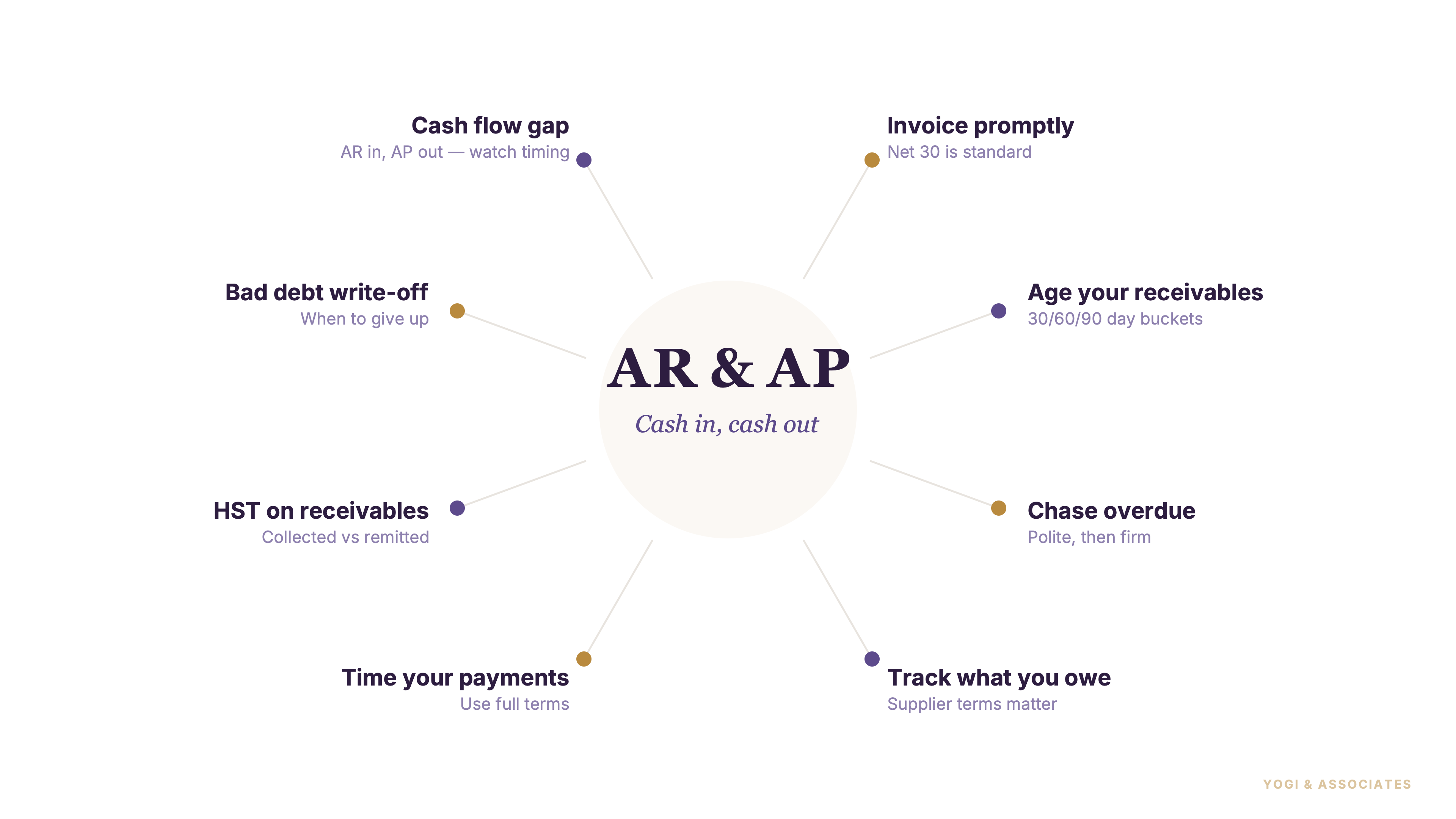
1. What A/R and A/P actually mean
For Ontario small businesses running on tight margins, the gap between who owes you and who you owe can make or break a month. Accounts receivable is money customers owe you for work already done or invoices already sent. Accounts payable is money you owe suppliers for bills you have received but not paid yet.
On the balance sheet, A/R is a current asset and A/P is a current liability. Owners should learn those two lines early, because they tell you where your cash is about to move next.
So if you need the bigger bookkeeping picture first, start with our bookkeeping guide for Canadian small businesses. And if you want the accounting basis underneath this, our cash vs accrual accounting post explains why A/R and A/P mostly matter once you are keeping books on an accrual basis.
2. Why both matter for cash flow
A business can show profit on paper and still run out of cash. That usually happens when customers are slow and suppliers are not.
If A/R is climbing, more of your sales are trapped in unpaid invoices. But if A/P is shrinking because you keep paying bills early, cash leaves even faster.
This is the simplest cash-flow lesson owners miss. So review A/R and A/P beside the bank account, not in separate silos. Plus our guide to reading financial statements shows where both balances sit and how they change month to month.
3. Read the A/R aging report properly
Your best A/R report is the aging summary. A/R aging (a report that groups unpaid customer invoices by how old they are — current, 30 days, 60 days, 90 days, or older) tells you which customers are slipping before the problem gets expensive.
The standard buckets are current, 0-30 days, 30-60, 60-90, and 90 plus. Anything drifting into 60 days deserves real attention, because collection odds usually get worse as invoices age.
Most bookkeeping software builds this report for you automatically. And the useful habit is not just printing it. Circle the oldest invoices, confirm the customer has the invoice, and ask whether there is a dispute, a cash issue, or just delay.
4. Chase late customers without burning the relationship
Good collections are not about sounding tough on day one. They are about being steady, clear, and boring.
The cleanest process is this: send the invoice with a clear due date, send a friendly reminder about a week before due, send a polite past-due note within a few days after due, call after 30 days, send a firmer written demand around 60 days, and decide by 90 days whether the file still deserves time. So the relationship stays intact, but the customer also sees you are paying attention.
But never let a customer train you to accept silence. In our view, owners wait too long to pick up the phone. And a short call usually works better than six soft emails.
5. Know the CRA bad debt rules
Sometimes an invoice is done. A bad debt (a customer invoice you've decided you'll never collect — once written off, it can be a deduction on the tax return) is not just a late invoice. It is one you have decided is uncollectible.
CRA says you can generally deduct a bad debt when the amount was already included in income, the debt has truly become uncollectible, and you write it off in your books in that same year. Owners should keep notes of reminders, calls, and demand letters, because that file supports why you treated the invoice as dead. Source: Canada.ca bad debts
So there is also an HST angle. If you already reported and remitted the HST on that credit sale, CRA says you can recover the HST you overpaid as a tax adjustment on your GST/HST return after the debt becomes bad, as explained on Canada.ca. But if cash comes in later, that recovery has to be reversed for the amount collected.
6. Use A/P terms without annoying vendors
On the payables side, the goal is not paying early. The goal is paying on time.
Paying on the last day of the agreed terms keeps cash in your account longer. That is the right default for most owners, because it gives you more room without damaging trust.
But there is one common exception: an early payment discount (a small discount a supplier offers if you pay within a short window — like 2/10 net 30, meaning 2% off if paid in 10 days, otherwise full amount in 30). So if the discount is real and your cash is healthy, paying early can make sense. Plus paying late with no discussion is usually a mistake, because good suppliers remember who respects terms and who does not.
7. Tie both sides back to HST every month
This is where A/R and A/P hit your HST return. Under the usual accrual method, CRA says if you issue the customer invoice before payment, you still report the HST in the reporting period that includes the invoice date, even if the customer has not paid yet.
On the supplier side, CRA says you can include GST or HST on purchases and expenses you have been invoiced for even if you have not paid the vendor yet. This is why owners should review payables with the same care as receivables, especially if you want clean ITC support. Source: Canada.ca what to include on your return and Canada.ca GST/HST return guidance
So the monthly routine should be simple: match invoices, review the aging, clear old payables, and confirm the HST numbers before filing. And if you want the input side broken out further, our input tax credits post goes deeper on ITCs and invoice support.
A/R and A/P issues usually show up as cash stress before they show up as a tax problem. If you want cleaner books and a tighter monthly process, we can help.
Book a Free Consultation