1. What the T2125 actually is
If you are self-employed in Ontario, the T2125 is the form that reports your business income to CRA. T2125 means Statement of Business or Professional Activities. It is the CRA form sole proprietors use to report business or professional income and expenses with their T1 personal return.
The form helps you calculate your gross income and your net income or loss. That matters because a lot of people treat self-employment like a side note, when CRA treats it like a real reporting bucket.
So if you invoiced clients, earned professional fees, or ran a small business in your own name, this is usually where the story gets told. Our Canadian tax preparation guide is the broader checklist around it.
2. Who has to file it
If you earned self-employment business, professional, or commission income, you are usually in T2125 territory. And CRA specifically says the form can also be used for self-employed commission sales.
Some partners who are individuals use T2125 too, using information from financial statements or a T5013 slip. We've found that this surprises people who assume T2125 is only for solo freelancers.
CRA also treats some modern income streams as business income, including self-employed commission income earned from social media influencer work or ride-sharing services. So the old “it was just a side hustle” line usually does not change the filing result.
3. Deadlines and instalments
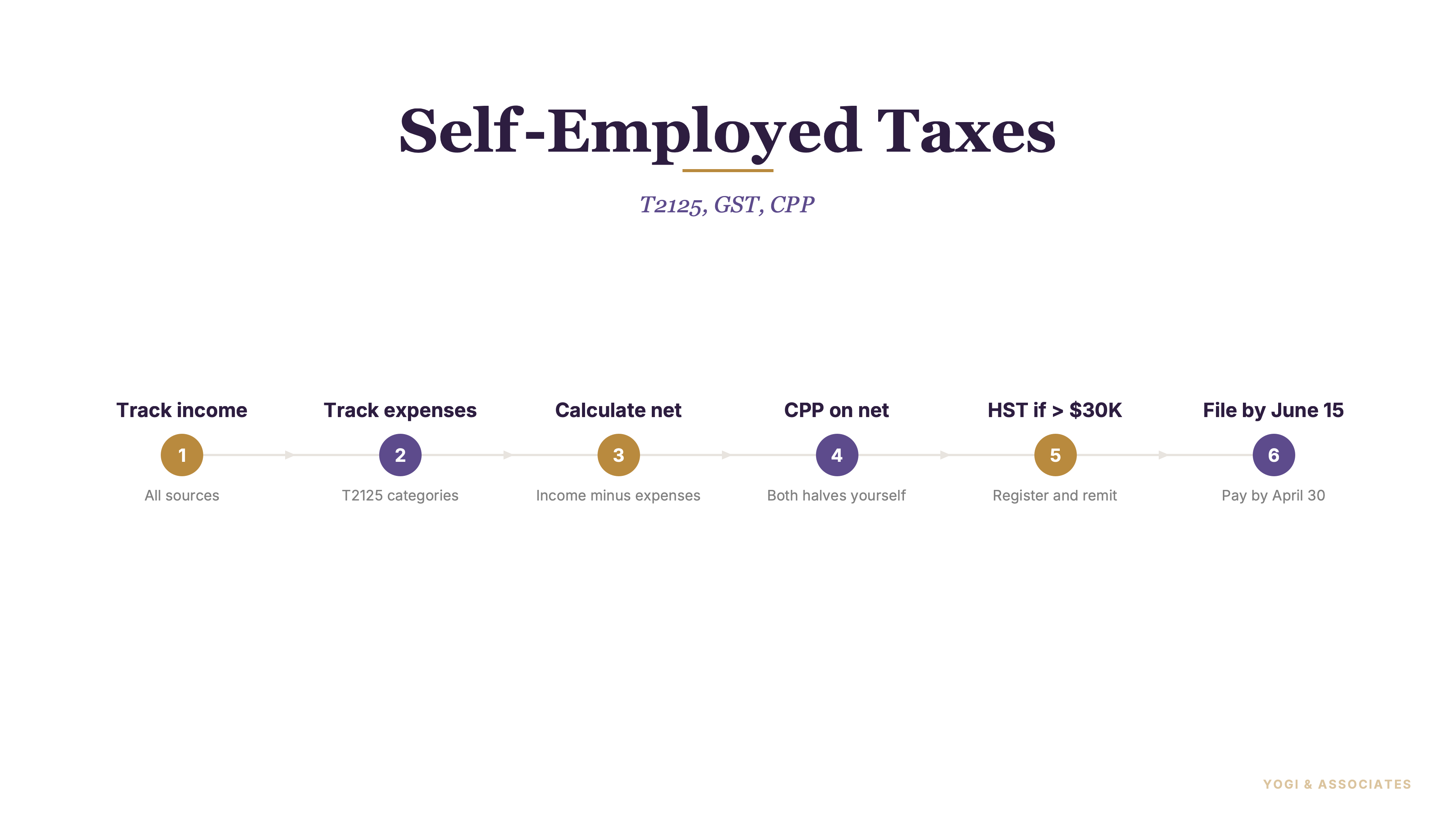
The self-employed filing deadline is June 15. But any balance owing is still due April 30, which is the part people remember too late.
CRA can also require instalments — quarterly prepayments toward next year's tax bill. people first notice them only after getting a reminder, but the rule is tied to net tax owing being more than $3,000 in the current year and in either of the two previous years.
So if your income jumped this year, do not wait for a surprise bill. Our tax filing deadlines guide helps with the calendar side of that plan.
4. GST/HST registration
A small supplier is the CRA term for a business still under the GST/HST registration threshold. Once worldwide taxable revenues go over $30,000 in a single calendar quarter or over 4 consecutive calendar quarters, you stop being a small supplier.
At that point, registration is no longer optional. This is one of the biggest traps for growing freelancers, because people track profit but forget to track taxable revenue.
Plus GST/HST is separate from income tax reporting on the T2125. If your deductions are the next question, our small business tax deductions guide is the right companion piece.
5. CPP for self-employed people
Self-employed people pay both the employee and employer portions of CPP. CRA says self-employed people pay the full 11.9% on net business income after expenses for the main CPP rate.
That is why the bill can feel heavier than expected, especially in a first profitable year. this is one of the fastest ways a good income month turns into a bad surprise at filing time.
So when you estimate tax, do not stop at income tax alone. CPP is part of the math and it hits cash flow right away.
6. Deductions people miss
The expense section of T2125 includes categories like advertising, office expenses, office stationery and supplies, professional fees, rent, repairs and maintenance, travel, utilities, delivery, motor vehicle expenses, and CCA. CCA means capital cost allowance — the CRA name for depreciation on equipment, vehicles, and other capital assets.
Meals and entertainment are on the form too, but the normal claim is capped at 50% of the allowable amount. We've found this is one of the easiest spots for people to overclaim when they are working from bank statements instead of proper records.
But the deeper question is often whether you should still be a sole proprietor at all. If incorporation is on your radar, compare this with our T2 corporate tax return guide and our salary vs dividends guide before making that jump.
7. Home office, vehicle, and CCA
You can claim business-use-of-home expenses if the workspace is your principal place of business, or if you use the space only to earn business income and on a regular and ongoing basis to meet clients, customers, or patients. The thing is, many people meet the first test and do not realize it.
For vehicle claims, CRA wants records of total kilometres and business kilometres. And CRA also accepts a simplified logbook method if you kept a full logbook for 1 complete year as a base year, then use a 3-month sample logbook within 10% of that base pattern.
CCA itself is claimed in Area A of the T2125. So if you bought equipment, tools, or a vehicle for the business, that deduction usually gets spread over time instead of being written off all at once.
Self-employed tax gets messy fast once income, GST/HST, CPP, and deductions start overlapping. If you want the filing cleaned up before CRA asks questions, we can help.
Book a Free Consultation